
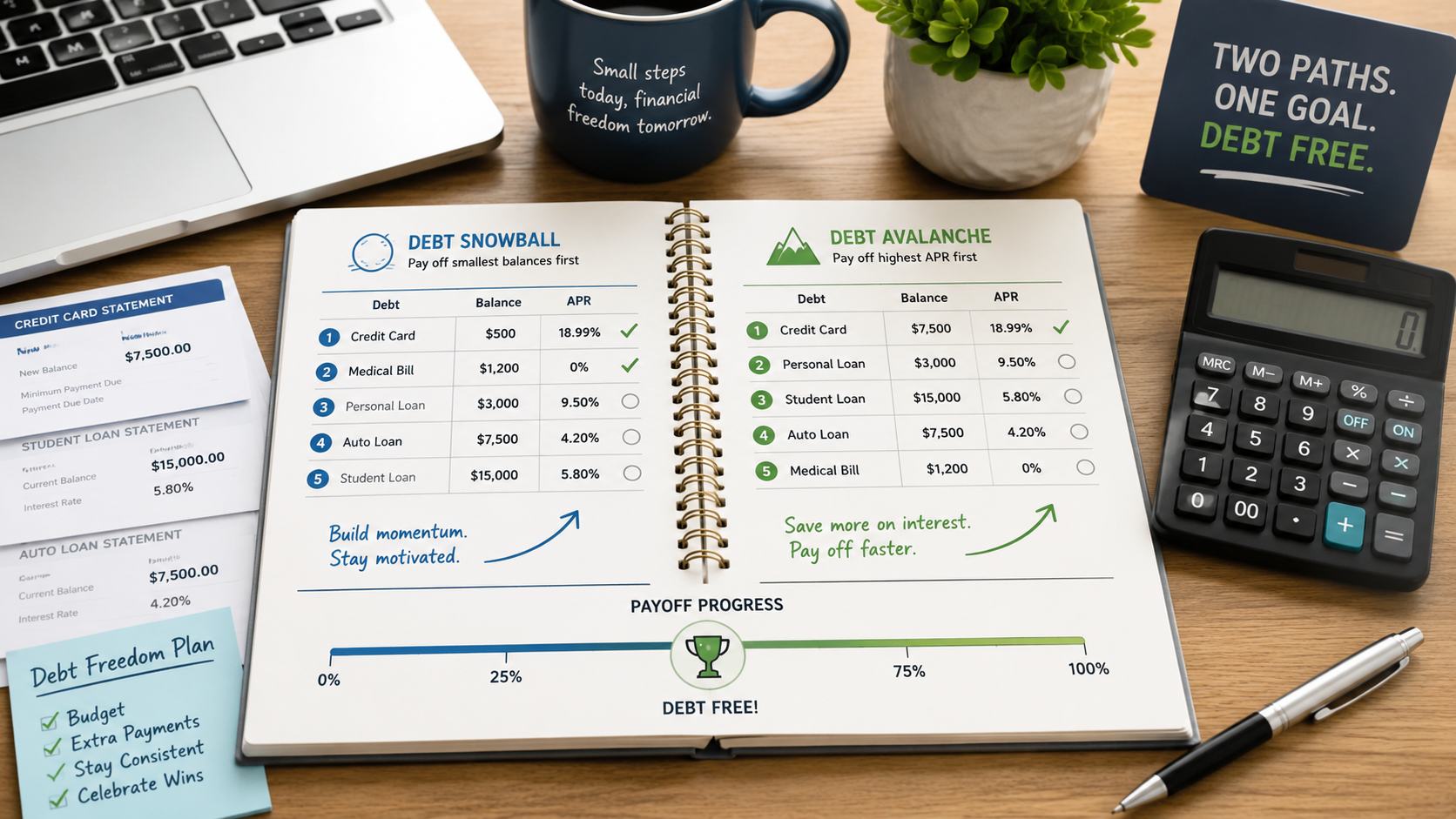
Which Method Actually Works Better?
Short Intro
If you’re carrying multiple debts — credit cards, a personal loan, maybe a car payment — the method you use to pay them off matters almost as much as how much you pay each month. Two strategies dominate the conversation: the debt snowball and the debt avalanche. Pick the wrong one for your personality and you might quit halfway through. Pick the right one and you could be debt-free faster, or save hundreds in interest. Here’s how each works, what the math actually says, and how to decide which one fits you.
Quick Answer
The debt avalanche saves you more money because it targets your highest-interest debt first. The debt snowball keeps you more motivated because it targets your smallest balance first, giving you quick wins. Mathematically, avalanche always wins or ties. Psychologically, snowball wins for most people — which is why, in practice, it’s often the method people actually stick with long enough to finish.
If you’re disciplined and numbers-driven: choose avalanche. If you’ve struggled to stay consistent with debt payoff before: choose snowball.
What Is the Debt Snowball Method?
The debt snowball, popularized by financial personality Dave Ramsey, orders your debts from smallest balance to largest, regardless of interest rate.
How it works:
- List every debt from smallest balance to largest.
- Pay the minimum on all of them.
- Throw every extra dollar you have at the smallest balance.
- Once it’s paid off, roll that entire payment (minimum + extra) into the next-smallest debt.
- Repeat until every debt is gone.
The “snowball” name comes from the fact that your payoff power grows with each debt you eliminate — like a snowball rolling downhill and picking up size.
Why people like it: the first debt disappears fast, which creates a visible, motivating win early in the process.
What Is the Debt Avalanche Method?
The debt avalanche orders your debts from highest interest rate to lowest, ignoring balance size entirely.
How it works:
- List every debt from highest interest rate to lowest.
- Pay the minimum on all of them.
- Throw every extra dollar at the debt with the highest APR.
- Once it’s paid off, roll that payment into the next-highest-interest debt.
- Repeat until every debt is gone.
Why people like it: it’s mathematically optimal. Because you eliminate the most expensive debt first, less of your money goes toward interest over the life of your payoff plan.
Side-by-Side Comparison
| Factor | Debt Snowball | Debt Avalanche |
|---|---|---|
| Payoff order | Smallest balance first | Highest interest rate first |
| Total interest paid | Higher | Lower (mathematically optimal) |
| Time to first win | Fast — often within a few months | Slower if your highest-rate debt has a large balance |
| Motivation factor | High — frequent small wins | Lower — progress can feel slow at first |
| Best for | People who need momentum to stay consistent | People who are disciplined and cost-focused |
| Downside | Can cost more in total interest | Can feel discouraging if the first payoff takes a while |
Motivation vs. Interest Savings: The Real Trade-Off
This is the heart of the debate, and it comes down to one question: will you actually finish the plan?
- Debt avalanche wins on math. Every dollar of extra payment is working as hard as possible against your most expensive debt. Over the full payoff period, this method almost always results in less total interest paid.
- Debt snowball wins on behavior. Personal finance is personal — behavioral research and years of anecdotal coaching data (including from Ramsey Solutions) suggest that quick, visible progress keeps people engaged. A method that saves more in theory is worthless if you abandon it in month four.
In many real-world cases, the dollar difference between the two methods is smaller than people expect — especially when your smallest balance also happens to carry a high interest rate. The behavioral difference, on the other hand, can be the deciding factor in whether you finish paying off your debt at all.
Useful Example: A Real Payoff Scenario
Let’s say you have four debts and $760 available each month to put toward all of them combined (minimums + extra):
| Debt | Balance | APR | Minimum Payment |
|---|---|---|---|
| Store Credit Card | $2,800 | 27% | $70 |
| Credit Card A | $1,500 | 22% | $40 |
| Personal Loan | $6,000 | 11% | $150 |
| Car Loan | $10,000 | 6% | $200 |
Total debt: $20,300 | Monthly budget: $760
Debt Snowball order (smallest balance first)
Credit Card A → Store Credit Card → Personal Loan → Car Loan
- First debt paid off: month 2 (Credit Card A)
- Fully debt-free: month 21
- Total interest paid: ≈ $1,509
Debt Avalanche order (highest APR first)
Store Credit Card → Credit Card A → Personal Loan → Car Loan
- First debt paid off: month 4 (Store Credit Card)
- Fully debt-free: month 21
- Total interest paid: ≈ $1,478
Result: In this scenario, avalanche saves about $31 in interest — a modest amount — while snowball delivers its first payoff twice as fast (month 2 vs. month 4). Both plans finish in the same 21 months because the total debt and total monthly budget are identical; only the order of payoff and the emotional pacing differ.
This is a common pattern: when your smallest balances aren’t wildly different in interest rate from your largest ones, the interest savings from avalanche can be small — while the motivational lift from snowball’s early win can be significant.
Mistakes to Avoid
- Splitting your extra payment across multiple debts. This dilutes your progress and slows down both methods. Always concentrate extra payments on one target debt at a time.
- Forgetting to keep paying minimums on every other debt. Missing a minimum payment can trigger late fees and credit score damage, wiping out any savings from your strategy.
- Switching methods midway. Bouncing between snowball and avalanche resets your momentum and makes it harder to track progress. Pick one and commit.
- Ignoring high-interest debt for too long under snowball. If your highest-rate debt also happens to be your largest balance, a strict snowball approach could let interest pile up for a long time. Consider a hybrid approach if this applies to you (see below).
- Not accounting for 0% promotional rates or upcoming rate hikes. A card with a temporary low rate can look deceptively cheap in an avalanche ranking — factor in when that rate expires.
How to Choose the Right Method for Your Personality
Ask yourself these questions:
- Have I started and abandoned a debt payoff plan before? If yes, lean toward snowball — you need the early wins.
- Am I motivated primarily by numbers and efficiency, not by visible progress? If yes, lean toward avalanche — you’ll stay engaged by watching interest costs shrink.
- Is there a large gap between my highest and lowest interest rates? If the gap is large (for example, a 27% store card vs. a 6% auto loan), avalanche will save meaningfully more money, which may be worth the slower start.
- Do I need a mix of both? Consider a hybrid approach: pay off one or two very small debts first for quick motivation, then switch to strict avalanche order for the rest. This “hybrid snowball-avalanche” approach is popular precisely because it borrows the psychological boost of snowball while preserving most of the savings from avalanche.
Action Plan
- List every debt with balance, interest rate, and minimum payment.
- Calculate your total monthly debt budget (all minimums + whatever extra you can add).
- Choose your order: smallest balance (snowball), highest rate (avalanche), or a hybrid.
- Automate minimum payments on every debt so nothing is missed.
- Direct every extra dollar to your top-priority debt only.
- Roll over the full payment to the next debt as each one is paid off.
- Track your progress monthly — visually, if possible, since seeing the numbers shrink reinforces the habit.
- Reassess every few months if your income, expenses, or interest rates change.
Final Thoughts
There’s no universal “better” method — there’s only the method that gets you to zero debt. The debt avalanche will save more money for most people, but only if they stick with it. The debt snowball may cost a bit more in interest, but its early wins keep many people in the game long enough to finish. If you’re unsure, a hybrid approach lets you capture some of both benefits. The best debt payoff plan is the one you’ll actually follow through to the end.
FAQs
Which debt payoff method is fastest? If your monthly payment budget is identical, both methods take almost exactly the same amount of time to become fully debt-free — the total amount of debt and total payment stay the same either way. The real difference is when you pay off your first individual debt: the snowball method typically clears your first debt faster (since it targets the smallest balance), while the avalanche method may take longer to celebrate its first payoff if your highest-interest debt has a larger balance. If “fastest” means overall payoff timeline, the methods are essentially tied; if it means fastest first win, snowball takes it.
Can I switch between snowball and avalanche partway through? Yes, though it’s best to decide upfront and stick with it. If you start with snowball for motivation and later want to optimize savings, you can switch to avalanche order for your remaining debts once you’ve built momentum.
Does the debt avalanche method hurt my credit score more than the snowball? No — both methods pay off the same debts using the same total dollar amount; only the order changes. Neither method inherently helps or hurts your credit score more than the other, as long as you keep making all minimum payments on time.
What if two debts have the same interest rate or similar balances? If rates are equal, prioritize the smaller balance for a quicker win. If balances are similar, prioritize the higher rate to save more on interest.